
It’s sad to say, but wine does have calories. A single 5-ounce glass of wine (one serving) can have as much as 300 calories(!) and as low as 80-90. In wine, calories mainly come from two sources: alcohol and sugar. Alcohol is the biggest contributor, with about 7 calories per gram, compared to sugar’s 4 calories per gram. This is why stronger, red wines like Zinfandel or Cabernet Sauvignon, which usually have a higher alcohol content, have more calories than lighter wines like Pinot Grigio or Riesling. Bottom line: If you’re hunting for low-calorie wines, watch the alcohol content.
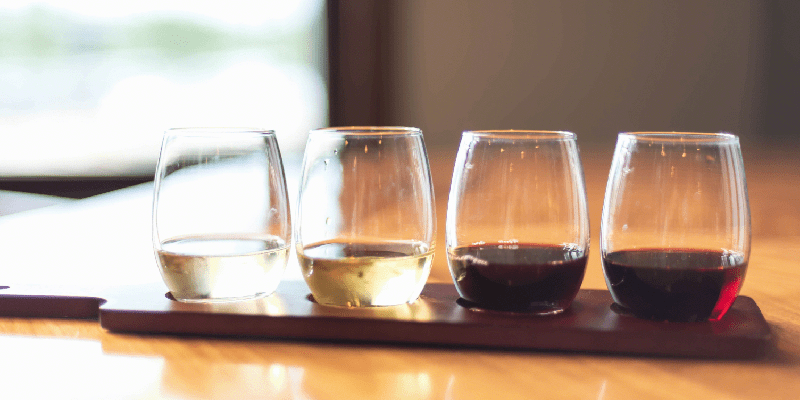
During the wine-making process, sugar in grapes turns into alcohol. However, sometimes not all the sugar gets converted. This remaining sugar, known as “residual sugar,” also adds to the calorie count. Wines like Moscato or sweet dessert wines are even more calorie-rich because they have higher amounts of residual sugar. Similarly, sweet wines like fortified wines with added alcohol can also be high in calories.
If you want to lower your calorie intake or sugar amount, you’ll want to make informed choices. Even if a bottle says “low calorie,” this usually means it has less alcohol or less residual sugar. The basic principles of what makes wine calorie-heavy or light remain the same. For a low-calorie approach, dry wines are generally a better option as they have less residual sugar and often a lower alcohol content. You can get a fairly good idea of a wine’s calorie content by checking its Alcohol by Volume (ABV) percentage and sugar levels, usually indicated on the bottle.
Below are some wine calories comparison charts, which are available to download as a PDF.
Wines With The Fewest Calories
| Wine Type | Calories per Glass | Sugar Content (g/L) | Alcohol Content (%) |
|---|---|---|---|
| Vinho Verde (White) | 85-100 | 0-3 | 9-10 |
| Muscadet (White) | 90-100 | 0-3 | 10-11 |
| Txakoli (White) | 90-110 | 1-2 | 9.5-11.5 |
| Albariño (White) | 95-110 | 0-3 | 11-12 |
| Picpoul de Pinet (White) | 95-110 | 0-3 | 11-12 |
| Provence Rosé | 95-115 | 0-3 | 11-12 |
| Champagne Brut Zero (Sparkling) | 100-115 | 0-3 | 11.5-12.5 |
| Txakoli (Sparkling) | 110-120 | 1-5 | 10.5-11.5 |
| Soave (White) | 110-120 | 0-3 | 11-12 |
| Grüner Veltliner (White) | 110-120 | 1-5 | 11-12.5 |
Calories in Red Wines
| Wine Type | Calories per Glass | Sugar Content (g) | Alcohol Content (%) |
|---|---|---|---|
| Gamay | 115-125 | 0-3 | 12-13 |
| Dolcetto | 115-125 | 0-3 | 12-13.5 |
| Pinot Noir | 120-130 | 0-3 | 12-14.5 |
| Cinsault | 120-130 | 0-3 | 12.5-14 |
| Montepulciano | 125-135 | 0-2 | 13-14 |
| Barbera | 125-135 | 0-2 | 12.5-14.5 |
| Aglianico | 125-135 | 0-2 | 13-14.5 |
| Carmenere | 130-135 | 0-3 | 13.5-14.5 |
| Tempranillo | 130-135 | 0-2 | 13-14.5 |
| Cabernet Franc | 125-130 | 0-2 | 12.5-14 |
| Sangiovese | 125-135 | 0-2 | 13-14 |
| Touriga Nacional | 125-135 | 0-2 | 13.5-14.5 |
| Nero d’Avola | 125-135 | 0-3 | 13-14.5 |
| Merlot | 125-140 | 0.5-3 | 13.5-14.5 |
| Chardonnay | 125-140 | 0.5-2 | 13.5-14.5 |
| Cabernet Sauvignon | 130-145 | 0.5-2 | 13.5-15.5 |
| Malbec | 130-145 | 0.5-2 | 13.5-15 |
| Syrah/Shiraz | 130-145 | 0.5-2.5 | 13.5-15 |
| Petite Sirah | 130-145 | 0-2 | 13.5-15.5 |
| Mourvèdre | 130-145 | 0-2 | 13.5-15 |
| Nebbiolo | 130-145 | 0-2 | 13.5-15 |
| Grenache | 130-145 | 0-4 | 14-15.5 |
| Grenache Noir | 130-145 | 0-4 | 14-15.5 |
| Tannat | 130-145 | 0-2 | 13.5-15.5 |
| Zinfandel | 140-170 | 0.5-4 | 14-17 |
Calories in White Wines
| Wine Type | Calories per Glass | Sugar Content (g) | Alcohol Content (%) |
|---|---|---|---|
| Riesling | 110-130 | 5-20 | 8-12.5 |
| Pinot Grigio/Pinot Gris | 120-130 | 0.5-3 | 12-13.5 |
| Sauvignon Blanc | 120-130 | 0.5-3 | 12-14 |
| Gewürztraminer | 120-130 | 1-10 | 12-14 |
| Chenin Blanc | 120-130 | 0.5-3 | 12-13.5 |
| Albariño | 120-130 | 0.5-3 | 12-13.5 |
| Grüner Veltliner | 120-130 | 0.5-3 | 12-13.5 |
| Vermentino | 120-130 | 0.5-3 | 11.5-13.5 |
| Soave | 115-130 | 0-2 | 11.5-13 |
| Garganega | 115-130 | 0-2 | 11.5-13 |
| Trebbiano/Ugni Blanc | 115-125 | 0-2 | 11-12.5 |
| Chablis | 125-135 | 0-2 | 12-13 |
| Sancerre | 125-135 | 0-3 | 12-13.5 |
| Assyrtiko | 125-135 | 0-3 | 13-14 |
| Viognier | 125-140 | 0.5-2.5 | 13.5-15 |
| Semillon | 125-140 | 0.5-2 | 11.5-14 |
| Chardonnay | 125-140 | 0.5-2 | 13.5-14.5 |
| Torrontés | 130-140 | 1-5 | 13-14.5 |
| Marsanne | 125-140 | 0-2 | 12-14 |
| Roussanne | 125-140 | 0-2 | 12-14 |
| Moscato/Muscat | 125-160 | 10-40 | 5-11 |
Calories in Sparkling Wines
| Wine Type | Calories per Glass | Sugar Content (g) | Alcohol Content (%) |
|---|---|---|---|
| Champagne | 100-115 | 0-3 | 11.5-12.5 |
| Txakoli (sparkling) | 110-120 | 1-5 | 10.5-11.5 |
| Conegliano Valdobbiadene Prosecco Superiore | 110-120 | 6-15 | 11-12 |
| Sekt | 110-135 | 4-20 | 10-13.5 |
| Lambrusco | 110-140 | 5-30 | 8-11 |
| Cava | 115-125 | 2-12 | 11.5-12.5 |
| Franciacorta | 115-125 | 2-6 | 11.5-12.5 |
| Crémant | 115-125 | 1-5 | 11.5-12.5 |
| Corpinnat (Spanish) | 115-125 | 2-6 | 11.5-12.5 |
| American Sparkling Wine | 115-125 | 2-12 | 11.5-12.5 |
| Metodo Classico (Italian) | 115-125 | 2-6 | 11.5-12.5 |
| English Sparkling Wine | 115-125 | 2-12 | 11.5-12.5 |
| Pezsgő (Hungarian) | 115-125 | 2-6 | 11.5-12.5 |
| Espumante (Portuguese) | 115-125 | 1-10 | 11-13 |
| Rosé Sparkling Wine (varies by region) | 115-130 | 1-10 | 11-12.5 |
| Alta Langa (Italian) | 120-130 | 1-5 | 12-13 |
| Blanquette de Limoux | 120-130 | 1-5 | 12-13 |
| Trento DOC | 120-130 | 1-5 | 12-13 |
| Vouvray (sparkling) | 120-130 | 1-10 | 12-13 |
| Sparkling Shiraz | 130-145 | 1-5 | 12.5-14.5 |
| Cerdon du Bugey | 130-150 | 20-35 | 7-8.5 |
| Moscato/Muscat | 125-160 | 10-40 | 5-11 |
| Asti | 150-170 | 30-50 | 7-9 |
Calories in Fortified Wines
| Fortified Wine Type | Calories per Glass | Sugar Content (g/L) | Alcohol Content (%) |
|---|---|---|---|
| Fino Sherry | 120-135 | 0-5 | 15-18 |
| Manzanilla Sherry | 125-140 | 0-5 | 15-19 |
| Dry Vermouth | 130-150 | 2-5 | 16-18 |
| Amontillado Sherry | 150-170 | 5-10 | 16-22 |
| Oloroso Sherry | 165-180 | 5-10 | 18-20 |
| Tawny Port | 190-210 | 30-50 | 19-22 |
| Ruby Port | 190-210 | 35-55 | 19-22 |
| Madeira | 190-220 | 35-60 | 18-20 |
| Sweet Vermouth | 190-220 | 40-80 | 16-18 |
| Marsala | 200-240 | 40-100 | 17-20 |
Wine Nutritional Information
You’ve got the basics of which wines have how many calories, but what about specific wines, or a wine we didn’t mention? Reading a wine bottle label can be tricky, but it’s a good way to guess how many calories you’re about to enjoy.
The first thing to look at is the Alcohol by Volume or ABV. This percentage is usually on the front or back of the bottle. The higher the alcohol content is, the more calories the wine has. If you want a lower-calorie wine, look for a lower ABV percentage.
If you’re watching your sugar, look for “dry” on the label. Dry wines have lower sugar content. For example, Riesling comes in both regular/sweet (higher sugar) and dry (lower sugar). A dry Riesling will almost always have the word “Dry” somewhere on the label.
Finally, think about how much wine you’ll pour. A standard serving size (pour) in a restaurant is about 5 ounces. A whole wine bottle usually has about five to six of these servings. To determine the calories for each glass, you can divide the total calories in the bottle by five. But remember, wines with higher ABV will have more calories in each serving, even if you pour less.
So even though wine labels don’t have all the nutritional info you might want, you can still get a good idea of the calorie content by looking at the ABV and thinking about your serving size.
